
2026 vs. 2025 Data Science job market 👀
7 job market trends you must know

I analyzed 101 Data Science job postings in 2026 and compared them to 2025. Here’s what I found.
1. The data engineering bar has risen.
SQL (+18pp), ETL/pipelines (+18pp), Snowflake (+10pp), dbt (+9pp) all surged.
Why: Companies now expect you to work directly with data infrastructure, not just consume clean tables. Tools like Snowflake, dbt, and Airflow have gotten accessible enough that you don’t need to be an engineer to use them. I think the DS role is heading to more a generalist Data role, where you’re expected to own Data projects end-to-end. Worth noting: this is 101 postings, so some of this shift could be noise.
So what: SQL and pipeline skills show up in the majority of DS postings now (79% and 31% respectively). If you’re a data scientist, I’d say familiarity with at least one modern warehouse and pipeline tool is going to be really helpful for staying relevant.
How to build this skill:
Step up to own a data pipeline at work. If your team has a messy data pull that someone manually runs, offer to turn it into a scheduled, version-controlled pipeline, even a simple one with dbt or Airflow.
Start writing your own SQL upstream instead of waiting for a data engineer to build you a table. Ask your data engineering team to pair with you on a query or review your work.
2. Experimentation and causal inference skills are growing.
A/B testing (+14pp) and causal inference (+17pp) saw large gains.
Why: To be honest, I’m not sure of the “forces” behind this increase. I think it’s a sign of Data teams maturing from descriptive and predictive analyses, to measuring impact.
So what: Experimentation and causal reasoning are among the fastest-growing skill requirements I found. If you’re building your skillset, I’d prioritize A/B test design, power analysis, and causal inference methods.
How to build this skill:
If your company doesn’t have an experimentation platform, this your opportunity. to step up to lead and to build a new skill. Offer to set up a lightweight framework or document a process for running tests. Start simple and small, and then build from there!
When you can’t run a true A/B experiment, try out some quasi-experimental methods: use difference-in-differences (DiD to evaluate a feature rollout, or apply propensity score matching (PSM) to compare user groups. Trust me, causal inference is going to be a highly sought after skill.
3. Legacy tools are fading.
SAS (15% → 2%), MATLAB (5% → 0%), Scala (9% → 1%), R (50% → 41%).
Why: SAS and MATLAB are losing ground to open-source tools. Python’s ecosystem (pandas, scikit-learn, PyTorch) covers most of what they did. Scala’s decline probably reflects the shift from Hadoop/Spark-centric architectures toward SQL-based warehouses. R is declining more gradually and still shows up in 41% of postings. You’ll still see it in biostatistics and academia, but Python is consolidating as the default in industry.
So what: R at 41% is still significant. It hasn’t disappeared. But the trend direction is clear. If you’re investing in a language for industry roles, Python is the safer long-term bet. SAS and MATLAB have dropped to near-zero in my sample; of course, this may not be true in across all industries.
How to build this skill:
If you’re an R user, it’s easy to learn Python. Start by rewriting one of your existing R analyses in Python. The overlap over between the two is significant, and translating familiar work is faster than starting from zero.
If you’re coming from SAS or MATLAB, lean on your statistical knowledge. That transfers directly to Python.
4. AI engineering is emerging but still niche.
LLM engineering (3% → 12%), agentic AI (0% → 8%), MLOps (4% → 11%), RAG (0% → 4%).
Why: A year ago, these skills barely appeared in DS postings. Now they show up in roughly 5-12% of them. Many tech are starting to build LLM products (features or standalone products) and internal tools, and they need people who under AI-powered systems, but architect and evaluate them.
So what: The vast majority of DS roles still don’t mention these skills. But the growth from near-zero is hard to ignore. If you pick up these skills now, you’ll have a real differentiator for certain roles. Whether this follows the same trajectory as “machine learning” (niche in early 2010’s, ubiquitous by ~2020) is something I’ll be watching closely.
How to build this skill:
Find a repetitive, low-stakes task at work (summarizing documents, categorizing support tickets, extracting info from unstructured text) and build a small AI-powered solution for it. You’ll get hands-on experience with prompt design, evaluation, and the messiness of real-world LLM outputs.
Focus on evaluation early. The hardest part of LLM engineering isn’t building, it’s knowing whether your system is actually working well. I see a lot of DS focusing on this particular skill because it’s highly impactful.
If your company is already building with LLMs, ask to join that project, even in a supporting role. Lean in to your expertise as a Data Scientist -- that means defining metrics, running experiments, and doing deep-dive analyses.
5. AI tools usage barely moved.
General AI tools (9% → 13%), ChatGPT/Copilot/prompt engineering all under 3%.
Why: This was very surprising to me. Despite how widely adopted AI tools are in practice, you barely see them mentioned in job postings. My best guess is companies might consider AI tool usage too basic to list (just like how they won’t list “Googling” as a requirement).
So what: The low numbers here are honestly ambiguous. They could mean it’s not important, or they could mean it’s assumed. Anecdotally, I see AI tool fluency becoming increasingly expected in practice. And also, keep in mind that some companies are testing your ability to work with AI in their interviews, so you definitely want to get familiar with using AI tools for your day-to-day work.
How to build this skill:
Start using AI tools in your actual day-to-day work. Use Copilot or Claude while writing analysis code, debugging SQL, or putting together documentation. The skill isn’t just about writing good prompts (which is important!). It’s also developing judgment about when AI output is trustworthy and when you need to verify it. And also understanding how to iterate on it.
Share what you learn with your team! (See point 7 - this is important!) Offer to demo a workflow or write up a short guide so others can learn from what you learned. This builds your reputation as someone who helps the team work smarter, and being the go-to AI expert is pretty neat.
6. Soft skills: more specificity, less filler.
Communication (+11pp), stakeholder management (+13pp) grew. Problem solving (-22pp), agile/scrum (-5pp) dropped.
Why: “Problem solving” had the single biggest drop in the dataset at -22pp. I don’t think it’s becoming less important of a skill. But I think it’s because it’s a generic phrase that doesn’t actually distinguish candidates. Meanwhile, communication and stakeholder management are growing because employers are getting more specific about the interpersonal skills they want. I also think this reflects how the DS role has become more cross-functional and generalist (become end-to-end Data product owners)
So what: Employers increasingly value your ability to communicate findings and manage stakeholder relationships. These are now mentioned more frequently than many technical skills.
How to build this skill:
Present your work more often, even informally. Offer to walk through a recent analysis in a team meeting or a lunch-and-learn. The best way to become a good communicator is to get your reps in!
Practice the “so what” habit: every time you finish an analysis, force yourself to write one sentence that a non-technical executive would care about. If you can’t, the analysis isn’t done yet.
Ask a stakeholder to co-define the problem with you before you start an analysis. This draws them in to be invested in your analysis, and also builds the relationship and ensures your work lands. From my experience, my biggest communication failures happened when I tried to answer a question that nobody wanted.
7. Seniority: slight shift toward senior roles.
Junior (10 → 7), Senior (3 → 7), Mid-level steady (81).
Why: I saw a small decrease in junior postings and an increase in senior ones. The numbers are small (single digits), and it’s all manually sampled, so this could just be normal variation. But a couple possible factors: maturing data teams may need more experienced hires, and AI tools might be changing the volume on junior hiring.
Caveat: The change is modest enough that I can’t draw firm conclusions from 101 postings. It’s worth monitoring in larger datasets to see if junior DS demand is genuinely contracting.
How to build toward seniority:
Senior data scientists are distinguished less by technical skill and more by their ability to pick the right problem, scope the work, and drive it to a decision. I.e. can you lead a project end-to-end. Look for opportunities to do so in your work, this will look great on your resume and sound good in your interviews.
Build a track record of influence. Keep a running doc of analyses you’ve done and the decisions they informed. This becomes your narrative for promotion conversations and interviews.
Mentor someone, even informally. Reviewing a junior work or helping a new coworker onboard; this builds leadership skills and visibility at the same time.
So anyway.. What are the top skills for Data Scientists in 2026?
I talked a lot about the changes between 2025 and 2026. But you might be wondering about the absolute list of required skills.
I ranked the most frequently mentioned skills across all 101 postings. Here’s what came out on top:
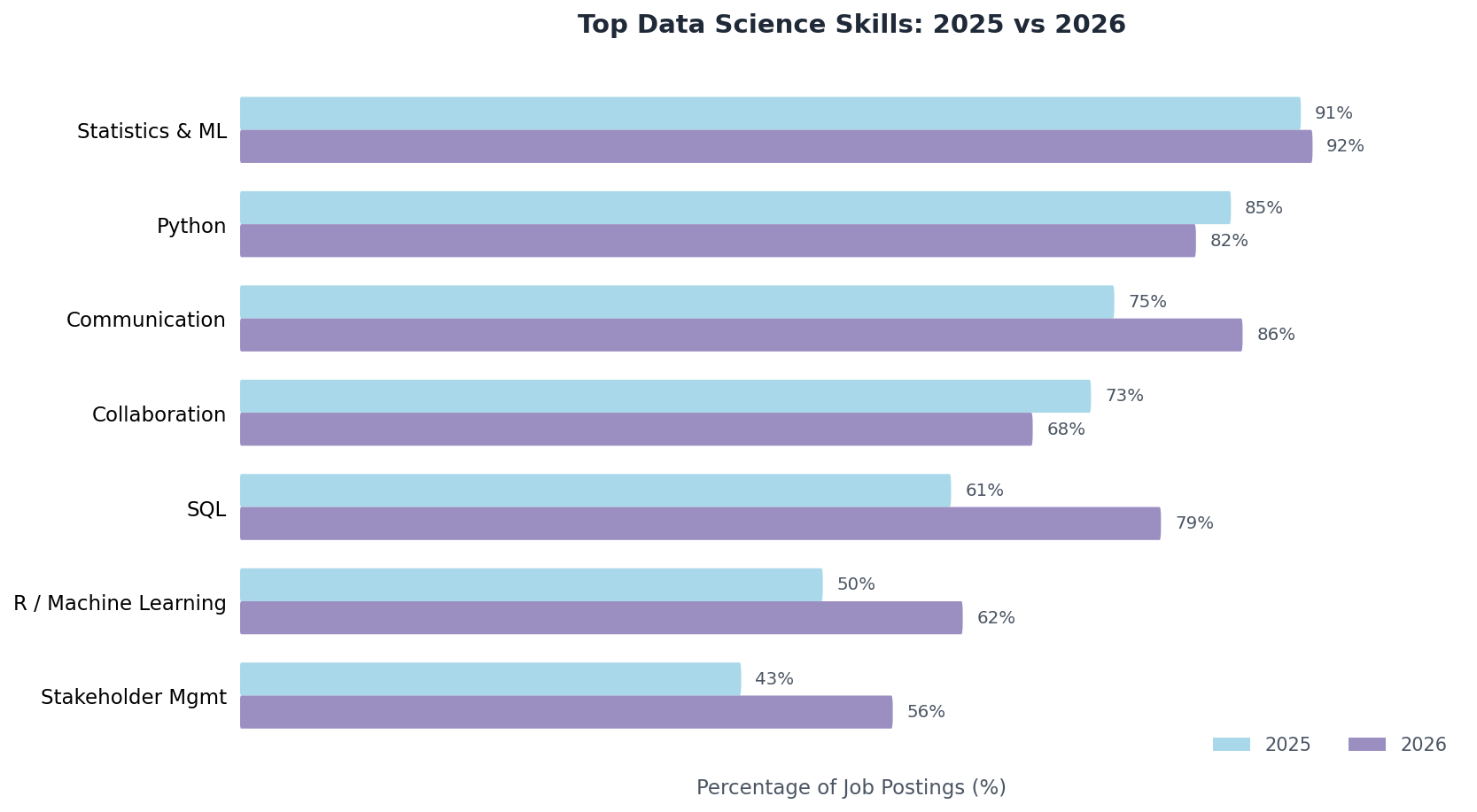
Statistics & ML (92%) - This one hasn’t changed. It was #1 in 2025 and it’s still #1 now. Your foundation in statistics and machine learning is still the most in-demand skill.
Communication (86%) - This jumped from #3 to #2. I talked about this earlier, but companies are getting way more intentional about wanting you to communicate your findings clearly. It now ranks above Python.
Python (82%) - Still essential, but it dropped from #2 to #3. I don’t think Python is becoming less important. I think communication is just becoming more important in the world of AI.
SQL (79%) - This is the big mover. SQL went from #5 in 2025 (61%) to #4 in 2026 (79%). That’s an 18 percentage point jump. If you’re not comfortable writing SQL, this is the year to change that.
Collaboration (68%) - Dropped slightly from #4 (73%) to #5 (68%). Still a core expectation, but it’s interesting that more specific skills like communication and stakeholder management are growing while the broader “collaboration” label is dipping.
Machine Learning (62%) - This wasn’t even in the top 7 last year as a standalone skill (it was bundled with Statistics). Seeing it called out separately in 62% of postings tells me companies want to make sure you can actually build and deploy models, not just understand the theory.
Stakeholder Management (56%) - Jumped from 43% to 56%. This lines up with what I said in section 6. Companies want you to manage relationships, not just deliver analyses into a void.
The big takeaway for me: the top 7 is now split almost evenly between technical skills and people skills. If you’re only investing in one side, you’re leaving gaps that employers are actively looking for.
The job market is brutal. A job posting can get hundreds of applications in a day.
Those are crazy numbers!
That’s why I recommend building a customized website for every job application. On the website, I include
↳ Reasons why I’m a good fit for THIS role
↳ My customized resume
↳ And… a picture of me already working at the company
All of this is built with Airtable AI agents. Here’s how it works:
𝗦𝘁𝗲𝗽 𝟭: I copy and paste the full job description (usually I find them on LinkedIn)
𝗦𝘁𝗲𝗽 𝟮: The Airtable field agents extract all the important information
Company, team and role
Required skills
Preferred skills
𝗦𝘁𝗲𝗽 𝟯: Then more field agents generate:
Customized resume bullet points and summary
An image of me wearing the company’s shirt
A polished website… i.e. my personalized pitch to the hiring manager & recruiter
𝗦𝘁𝗲𝗽 𝟰: I include the website on my application & outreach messages
And that’s it.
It takes less than 10 minutes per job application, and the whole thing runs automatically every time you add a new listing. No additional prompting needed, because the Field Agents remember the context.
You can use this template I built with Airtable → https://www.airtable.com/lp/dawn
ICYMI (in case you missed it!)
My LinkedIn Learning course on automating reporting with n8n is LIVE. Check it out here!
A cheatsheet on Window Functions in SQL
Python skills Tier List
Logistic Regression + Monte Carlo simulation for March Madness
Getting started with SKILLS in Claude Code